
One of the most common frustrations among anglers using trolling motors isn’t the motor itself — it’s the battery setup. Many first-time buyers ask the same question:
“Why does my trolling motor run out of power so quickly?”
The truth is, battery choice, wiring, and usage habits play a far bigger role in performance than most people realise. This guide breaks it all down in simple terms, so you can get the maximum runtime, reliability, and lifespan from your trolling motor.
Why Battery Choice Matters More Than Motor Size
Your trolling motor is only as good as the power feeding it. Even a perfectly sized motor will underperform if paired with the wrong battery.
Key factors that affect runtime:
- Battery type
- Amp-hour (Ah) rating
- Motor thrust level (34lb, 44lb, 54lb)
- Boat weight and load
- Speed setting used
- Water and wind conditions
Understanding Battery Types for Trolling Motors
1. Deep Cycle Lead-Acid Batteries
✔ Affordable
✔ Widely available
✖ Heavy
✖ Shorter lifespan if deeply discharged often
Best for: Casual anglers, occasional trips
2. AGM Batteries
✔ Maintenance-free
✔ Better vibration resistance
✔ Slightly longer lifespan
Best for: Regular anglers who want reliability without lithium pricing
3. Lithium (LiFePO₄) Batteries
✔ Extremely lightweight
✔ Much longer lifespan
✔ Faster charging
✔ Delivers consistent power
Best for: Serious anglers and long sessions
💡 Pro Tip: Lithium batteries deliver nearly full power until depleted, unlike lead-acid which fades gradually.
How Long Will Your Trolling Motor Last? (Realistic Estimates)
Here’s a real-world runtime guide using a 100Ah battery:
| Motor Size | Speed Setting | Estimated Runtime |
|---|---|---|
| 34lb | Medium | 6–8 hours |
| 44lb | Medium | 4–6 hours |
| 54lb | Medium | 2.5–4 hours |
⚠️ Running at full speed continuously can cut runtime by more than 50%.
Common Mistakes That Kill Battery Life
❌ Using car batteries instead of deep cycle
❌ Running at full throttle all day
❌ Poor wiring or thin cables
❌ Not fully charging after every trip
❌ Storing batteries partially discharged
Correct Wiring & Setup (Often Overlooked)
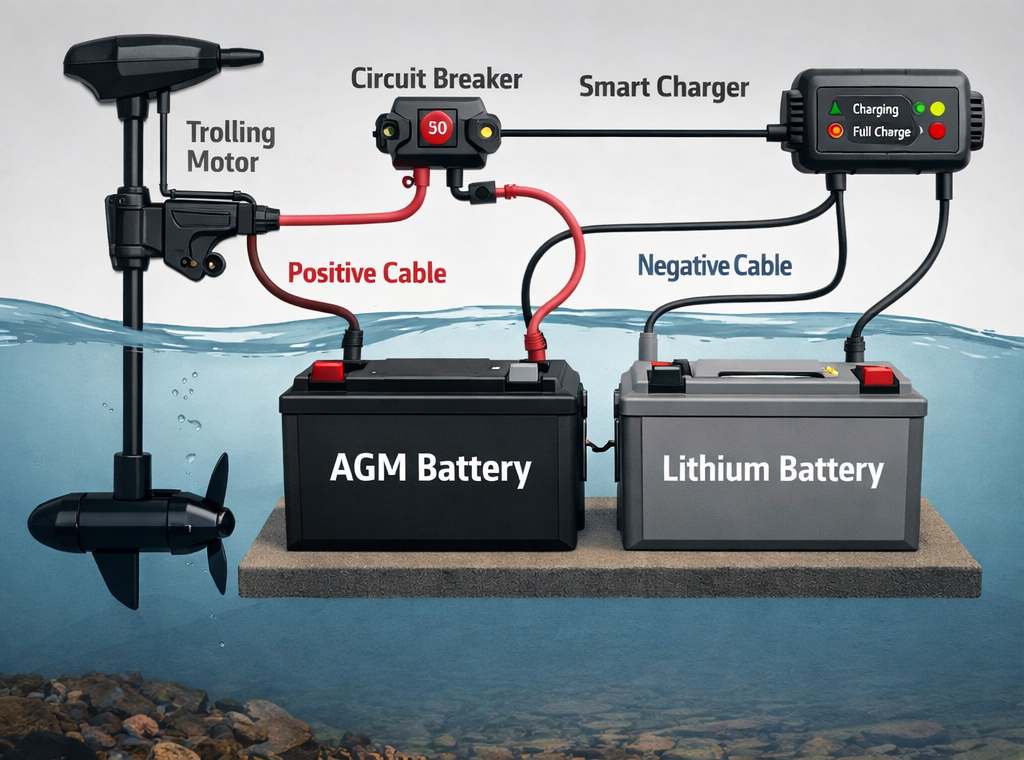
- Use marine-grade wiring
- Keep cable runs as short as possible
- Ensure tight, corrosion-free terminals
- Use a dedicated circuit breaker
- Never mix old and new batteries
A poor wiring setup can reduce available power by 10–20% instantly.
Charging Tips That Extend Battery Life
✔ Use a smart charger matched to your battery type
✔ Fully recharge after every outing
✔ Avoid overnight trickle charging on lithium
✔ Store batteries in a cool, dry area
How to Choose the Right Battery for Your Motor
34lb Motors
- Minimum: 80Ah
- Recommended: 100Ah AGM or Lithium
44lb Motors
- Minimum: 100Ah
- Recommended: 120Ah+ Lithium
54lb Motors
- Minimum: 120Ah
- Recommended: Dual-battery or high-capacity lithium
Final Thoughts
Most trolling motor “issues” are actually power issues. Once your battery setup is correct, your motor will feel stronger, last longer, and give you far more confidence on the water.
If you’re investing in a quality trolling motor, don’t under-invest in the power system that drives it.